

We’ve all been there. You see the potential of Artificial Intelligence: the way it can streamline operations, predict customer needs, and give your business a competitive edge. You sign up for one of the big public cloud providers, spin up a few powerful GPUs, and start experimenting. It feels like the future.
Then the first bill arrives.
Suddenly, that “pay-as-you-go” dream feels more like a nightmare. You’re staring at line items for data egress, cross-region replication, and premium support tiers you don’t remember authorizing. It’s enough to make any CFO reach for the aspirin.
The Public Cloud: A Taxi Ride That Never Ends
Think of the public cloud like a taxi. If you need to zip across town once a month, it’s brilliant. You don’t have to worry about maintenance, insurance, or parking; you simply pay for the miles you use.
But what if you were planning a cross-country road trip? Or commuting four hours every single day? Suddenly, paying by the mile becomes the most expensive way to travel.
AI training and long-running inference workloads are much the same. They require significant, consistent compute power. In the public cloud, hourly GPU rates – which can range from around $3 to more than $30 per hour depending on the instance – start to stack up surprisingly quickly. And unlike a taxi, many public cloud providers charge you to take your luggage – your data – back out of the car when the ride is over.
Public cloud remains an excellent choice for development, testing, and workloads with highly variable demand. The challenge begins when AI projects move beyond experimentation and into production.
Why AI Budgets Bleed in the Public Cloud
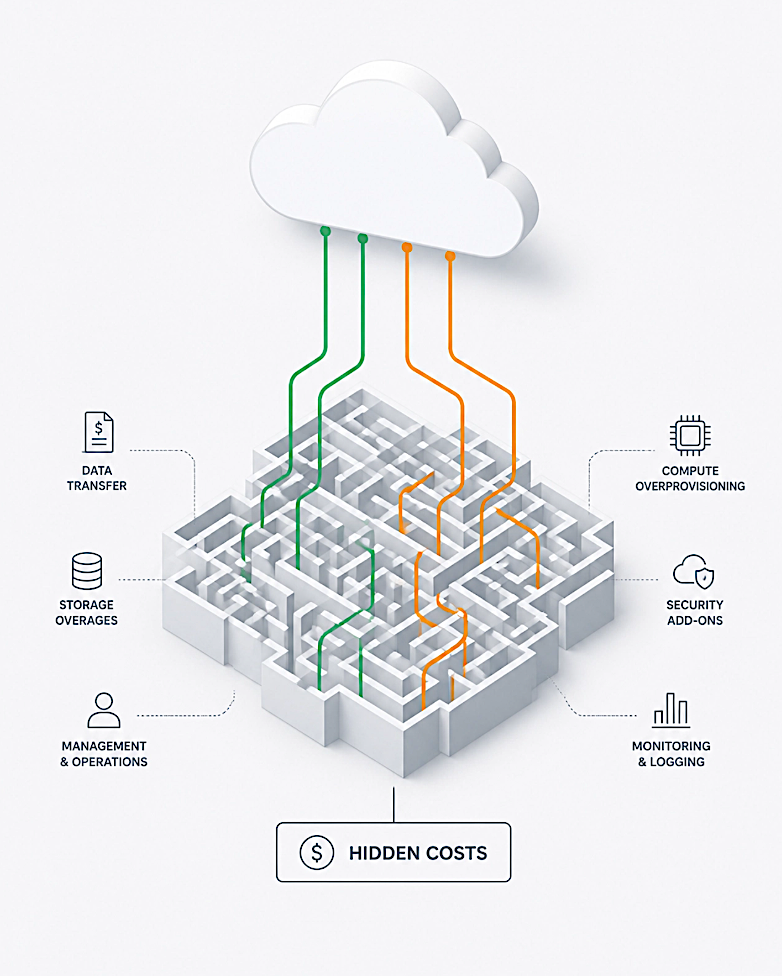
When we talk to mid-size and large enterprises, the frustration is rarely about the technology itself. It’s about the lack of predictability. Here’s why public cloud often fails the AI budget test.
The Egress Tax
Public cloud providers make it easy – and usually free – to move your data in. Moving it back out is another story. For AI models that rely on large datasets, egress charges can become a meaningful part of the overall infrastructure bill.
The “Spot” Gamble
Spot Instances can reduce costs by offering discounted GPU capacity, but that capacity can be reclaimed by the cloud provider at any time. If a deep learning model has been training for three days, an unexpected interruption can mean lost progress, additional compute time, and unnecessary expense.
Regional Hopscotch
The GPUs you need aren’t always available where your data lives. Running workloads in another region often means paying additional transfer fees while introducing more complexity into the environment.
None of these costs are necessarily obvious when an AI project begins. They become visible as workloads grow, GPU utilization increases, and infrastructure becomes part of day-to-day operations.
Private Cloud: Built for Predictability
Private cloud offers a different approach.
Instead of sharing infrastructure with thousands of other tenants, your AI workloads run in a dedicated environment designed around your business requirements.
You aren’t paying for the potential to scale. You’re investing in infrastructure built to deliver the performance your workloads actually require.
The Math of Predictability
We find that for many AI workloads, there is a tipping point. If your GPUs are consistently running at more than 40–50% utilization, private cloud often becomes the more cost-effective option.
Why?
Flat-fee data movement
Moving large datasets between your private cloud environment and GPU-accelerated workstations shouldn’t result in another unexpected bill.
Infrastructure designed for long-term value
Rather than paying premium hourly rates indefinitely, you’re investing in infrastructure that delivers predictable performance and predictable costs over time.
Clearer cost visibility
When you’re planning budgets, forecasting growth, or scaling AI initiatives, predictable infrastructure costs are far easier to manage than constantly changing consumption charges.
Why the Human Factor Still Matters
Public cloud platforms are built for enormous scale. That’s their strength.
But when something goes wrong with your AI pipeline at 2:00 AM on a Saturday, you may find yourself searching documentation or waiting for a support ticket to move through the queue.
With the right private cloud partner, you have direct access to engineers who understand your environment.
We aren’t just hosting your AI; we’re helping you build the outcomes you need.
Whether that’s optimizing your networking to reduce latency, designing GPU infrastructure that scales with demand, or implementing disaster recovery so your training data is protected, we handle the technical heavy lifting so you can focus on your core business.
Is It Time to Defend Your AI Budget?
The excitement of AI shouldn’t be overshadowed by the uncertainty of your next cloud invoice.
If rising cloud costs are making it harder to plan, scale, or justify AI investment, it may be time to take a closer look at your infrastructure strategy.
We can help you audit your current cloud spend, identify hidden infrastructure costs, and design a private cloud or hybrid environment that aligns with both your technical requirements and your AI budget.
Get back to focusing on your business, and let us handle the infrastructure. Reach out to the CenterGrid team to start the conversation.
Read our related article: When Public Cloud Stops Making Financial Sense.